September 6, 2026
A product catalogue at scale
Forty products, five formats each, one look. This is the job where a node canvas stops being a novelty and becomes the only sane option.

One hero image is a prompt-box job. Two hundred images that all have to look like they came from the same studio is a systems job, and the gap between those two is where a canvas earns its keep.
Build the machine once
The structure is a small graph: a product reference, a shared art-direction node, and one branch per output format. Your art direction is written once and inherited by every branch, so the catalogue comes out consistent by construction and not by you checking every file.
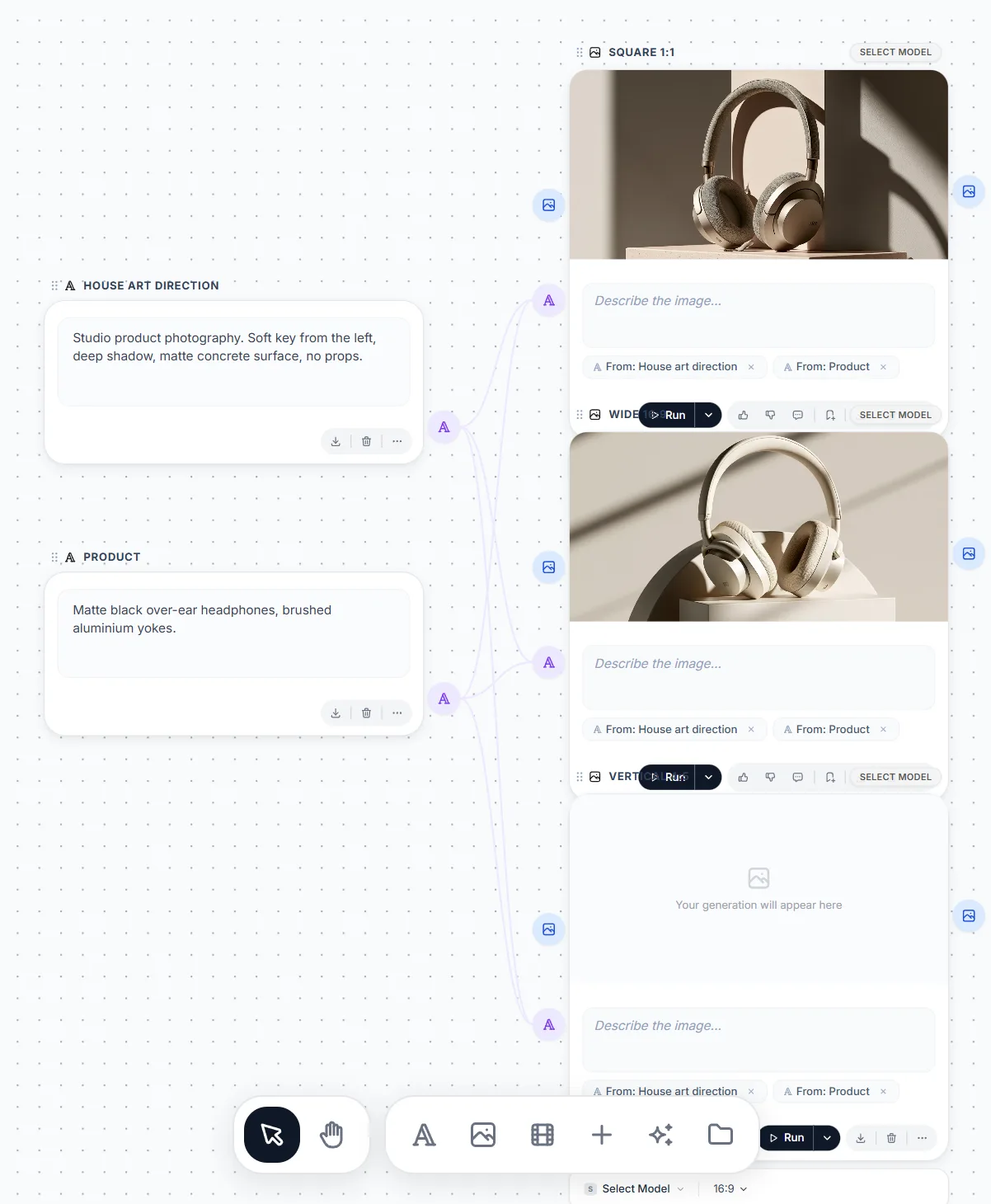
One art direction and one product, feeding a branch per format. Change the direction once and every format re-directs with it.
Then vary only the product
Every product gets a reference: what never changes about it, plus whatever photographs the supplier already sent you. Point the graph at a different reference and the same machine produces the next product in the same house style.
| Held constant | Varied per run |
|---|---|
| Lighting, lens, grade, background treatment | The product reference |
| Output formats and crops | Nothing |
| Post-processing and export settings | Nothing |
The parts worth automating
- Crops as branches, not a second pass. Square, 4:5, wide and banner all come out of the same run, so nobody is cropping by hand afterwards.
- Composition is free. Contact sheets and review grids cost no credits, so build them into the graph and look at the whole set at once.
- Save the winners back. The shot that defines your house look belongs in the library as a style reference.
Where we'd be careful: generative models are still weakest at exact product fidelity, so precise logos, fine text and small mechanical detail are risky. Use them for context, environment and mood, and keep the pack shot photographic.